
4.Theory into Practice
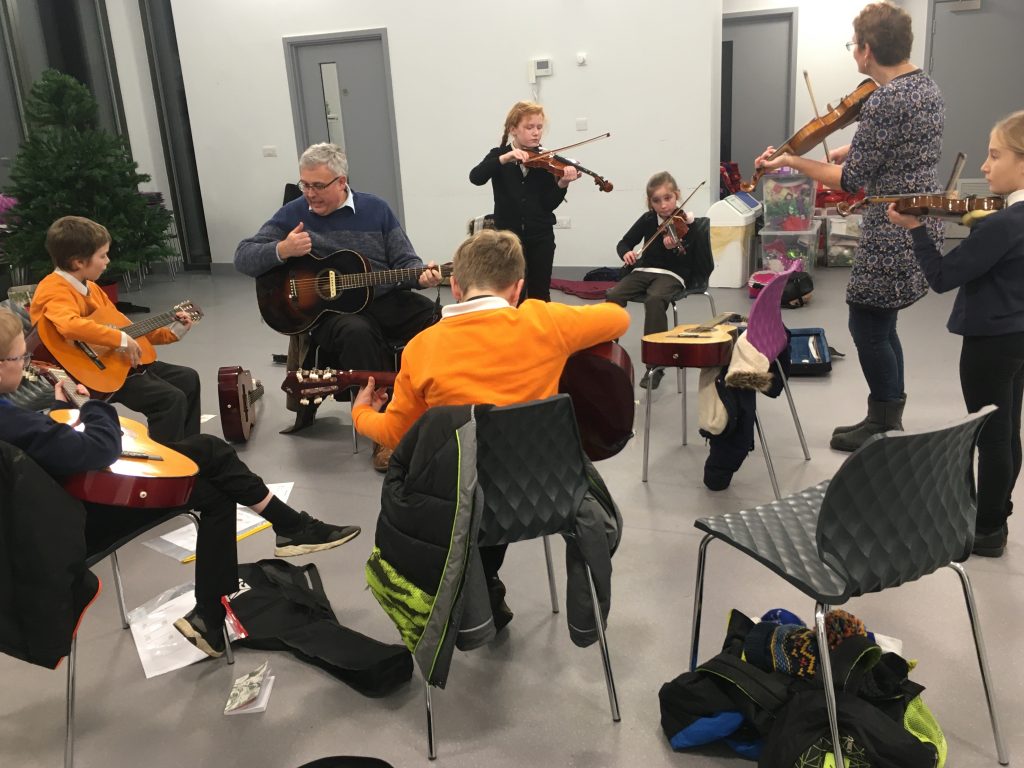
The definition of community music being used in this project is one as defined by Higgins “an active intervention between a music leader or facilitator and participants” (2012:1) and represents an approach to active music making and musical knowing outside of formal teaching and learning situations .The concept revolves around the premise that ‘everyone has the right and ability to make ,create, and enjoy their own music’ with a drive to ‘foster confidence in participant’s creativity’. This fits along with ‘the progression to develop active musical knowing and doing’ (Higgins 2012:3).
Tapson et al in their study of two UK ensembles mention the fact that ‘little attention has been directed at the impact of participatory music making …….upon health and wellbeing’ and refers to the fact that ‘understanding the challenges faced by community music projects can help support sustainability as well as inform understanding of health and well-being in community settings’. (Tapson, Walters and Daykin 2018:289).
Their pilot study of two community ensembles undertaken within the United Kingdom suggests that community music initiatives are more than a musical learning space but ‘engender connectivity, wellbeing….. a sense of connection with the community’. (Tapson, Walters and Daykin 2018:305).
The difficulty in providing hard data to corroborate the perceived positive effects of community music projects, particularly in areas within the deprivation index, is highlighted by the project ‘Notes for Notes’ which runs an after school provision providing free musical resources for youth. This project, similar in outlook and ethos to the planned Burnfoot Housing Estate project, has ‘since its creation in 2007, not had a chance to examine formally the positive impact it has had on its members and has relied on anecdotal evidence to gauge such impact.(Sheltzer et al 2019:2)
A study of the literature pertaining to the role of arts activities in promoting mental wellbeing and resilience in young people aged 11 – 18 was undertaken in 2017 by Zarobe and Bungay. Their remit was specifically to search out extracurricular activities that took part in community settings
Only studies related to activities that took place within community settings and those related to extracurricular activities based out with schools were included. Whilst limited by the search terms utilised and ,with the aforementioned, dearth of data led research evidence they found that ‘participating in arts activities can have a positive effect on self-confidence, self-esteem, relationship building and a sense of belonging, qualities which have been associated with resilience and mental wellbeing.’(Zarobe and Bungay 2017:337).
The Sistema project, nearer in geographical terms to my Scottish Borders based project, is ‘described as ‘ setting up a pilot social transformation programme called the Big Noise, teaching children from the Raploch estate near Stirling to play instruments within the context of an orchestra’ (Jourdan and Holloway 2017:Chapter 42:1). The Sistema Scotland team works on the basis that musical excellence and social transformation proceed hand in hand, that high aspirations and excellence in teaching and learning are key to change (Jourdan and Holloway 2017 Chapter 42:3.5). The question of musical identity and how the children see their musical selves was also evidenced in a formal qualitative evaluation of the Sistema programmes in both Raploch and Govanhill (Harkins et al 2016) who summarised that the ‘qualitative findings indicate that participation in the Big Noise programme enhances participant mental and emotional wellbeing in three ways’ and refer to the ‘happiness and enjoyment’ of musicmaking as well as the ‘participative benefits of security and belonging’ along with a ‘pride in their own achievements’. In their discussion the authors are careful to add in the ‘Discussion’ section that these ‘ findings add to a limited and under-theorised evidence base concerning the targeted use of community-based music programmes’ .
In a completely different approach the Community Orientated and Opportunity learning (COOL) Music project ‘challenges the prevailing model of top-down, catch-all, orchestra-based projects for improving well-being through music-making in Scotland, in favour of a more modest, bespoke and responsive bottom-up approach This project, based in Glasgow, operated for 12 months – a limitation considered as being ‘potentially disruptive’ where consistency is preferable. Nevertheless, the authors conclude that in project delivery concerning the ‘improved health and well-being of young people, the ‘bigger is better’ approach may not always be applicable (Millar et al 2020:95).
It is with these theoretical and practical examples in mind that the ‘Burnfoot Buskers’ pilot project is borne. Prior experience in a nearby area, as previously described, has driven this model to be implemented. Aware of the paucity of conclusive hard data there is nevertheless no doubt that the engagement in music making and being part of a musical group is of benefit to young people for many reasons varying from the sheer ‘joy involved’ to the ’sense of musical identity’ not to mention the emotional intelligence aspect which can benefit all areas of the young person’s life.
Extraneous factors affecting participation in music in the Burnfoot estate, Hawick appear similar to those encountered in Bannerfield, Selkirk (twelve miles away) – geographical isolation, poor transport infrastructure, funding policy and provision within schools and financial situation. By bringing music into the area and providing free instruments and tuition delivered in a child friendly, responsive, and interactive approach it is hoped to reach as many young people as possible. Whilst nowhere near reaching the grand project and infrastructure as shown by the ‘Big Noise’ in Raploch the intervention of small community led initiatives (the local enthusiast!) can drive engagement with a band reflecting the name of the estate regarded locally with some pride. As mentioned by the COOL music initiative projects do need to be sustained. This pilot project is, it is to be hoped, a forerunner of a longer term community group. Some discussion regarding this will follow in the next section.
Sheila Sapkota 14007570. Burnfoot Housing Estate. Community Music Project