
5.Implementation & Evidence
Start up Process :Funding, Dates and Publicity
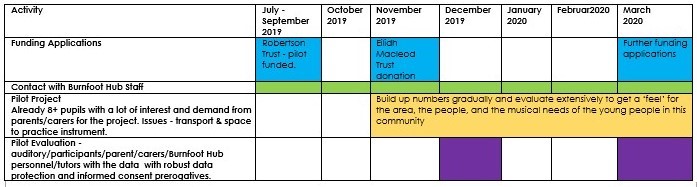
- A grant from the Robertson Trust allowed this project to commence. This allowed venue hire, publicity (including fliers), snacks, tutor costs and travel to be met as well as instrument maintenance and insurance cover. Advance publicity was kept fairly low key with the planned target being a small (maximum 10) group of children with further funding and a larger cohort being sought at the end of the trial period with a view to setting up a more permanent group in September 2020.Eight to ten workshops were originally planned for.An additional donation (unsolicited) – from the Uist based Eilidh Macleod Trust in memory of a promising young musician – in November allowed further workshops to be added on With the combined funds it was hoped to run sessions up to the 30th of March with some form of programme also envisaged for the summer term Actual dates are in table below and in Appendix 6 and included a gap due to the venue being unexpectedly (for us) refloored in January. The COVID 19 pandemic caused serious issues as became obvious in February. This will be covered in the next section.
Pathway to Progress
- Discussion with the community hub (and with Burnfoot primary school targeting primary 4/5 pupils).
- Identification of a suitable day and time after school with twelve weekly workshops set up teaching fiddle and guitar (myself and a guitar tutor).
- Distribution of fliers in the community and within the school
- Contact with interested pupils and their parents to explain the purpose of the music group to be formed – this meeting would include a core of pupils from Bannerfield Buskers to give their perspectives on the learning process and barriers encountered.
- Identification of pupils who would benefit (in practice we accept everyone) – the main factors desired are enthusiasm and commitment.
- Discussion to ascertain the instrument preferred (young people must choose themselves after trying out both fiddle and guitar) whilst explaining that singing is also an integral part of learning.
- Pupils work with tutors with the repertoire guided by them with the option ,if group is sustained long term, to start to work through traditional music grades from the Royal Conservatoire Scotland encouraged.A push towards own compositions around historic events and local borders events is actively encouraged.
- Performances/hub café performance and busking locally to boost skills and confidence as well as showcasing a local community initiative.
Teaching Strategies and Issues
- Clear and concise consent forms to be gone over with parent/carers at start
- High staffing ratio to allow small group work with support individually tailored to each individual
- Provision of business insured staff car to collect any child who is unable to attend due to transport issues and to facilitate visits.
- Fully disclosed positive reflective music tutors.
- Correctly sized instruments (half and three quarter sized guitars and quarter sized fiddles) with comfortable shoulder rests (furniture foam at correct size with rubber band suffices) and comfortable guitar straps.
- Ensure every child achieves their full potential – positive, enthusiastic approach with every individual making them and their contribution valued and every idea valued.
- Make it fun! make it cool! Show them the relevance of making music, composing, and thinking creatively! Build up resilience to cope with the inevitable ups and downs of learning an instrument. make them look around at their area – live their history.
Table 2. Evidence Framework
| What? | Who? | What? | When? |
|---|---|---|---|
| Initial Questionnaire (Appendix 3) | Young start up musicians | Clear, colourful questions using direct language, minimal options and allowing pictorial answers. Coloured background to facilitate minimise contrast. | First session attended November/December |
| Attendance weekly with representative photo & video clips of activities | All young musicians | Register of attendees. | 2019/2020 4th,11th,18th,25th Nov. 9th Dec. 20th,27th Jan. 3rd,10th,24th February 2nd,9th,16th March |
| End of block interview (Recordings - Appendix 3) | Young musicians, a parent, a manager at Burnfoot Hub, tutors | ipad recording of the answers to five basic questions in a semi structured interview conducted by an adult known to the young folk (Riddell Fiddles' tutor David Scott) | March 2020 |
| Engagement with post block music initiatives due to COVID 19 (Reflections section) | Young musicians | Free Online Zoom lessons (1:1) Instrument tuning conducted safely Online teaching videos on Riddell Fiddles website | March - June 2020 |
Material Evidence
A combined approach following on from the ‘Theory in Practice’ page is supplemented by a qualitative based data gathering approach. This involved a semi-structured ‘loose’ interview with participants including parent/s, hub stuff and young musicians attending the workshops.
Ethics Approval from the University of Highlands and islands has been granted for this project. A consent form (Appendix 3) has been signed by the parents/carers of all participants. Staff working with the young people are fully disclosed.
To validate the qualitative data gathered a robust analytical methodology included the following steps.
- Photographic and video recording of a sample of the teaching situations within the group.
- A transcription process of the interviews recorded resulting in a category (code) led table (Appendix 5)
- A visual mind map format summarising the salient points of the data gathered as a result of the transcription – see ‘Outcomes and Commentary’ – note that the data used, whilst representative, is not comprehensive (Appendix 5).
This step by step approach is common practise and is described in Warwick University’s ‘Analysing Interview Data online resources (Barnes, S. & Hoyos de, M. 2012:29).
Data analysis was conducted in such a manner as to ‘avoid bias with an attempt not to rely on first impressions or focus in on data confirming the research questions’ as described by Barnes et al (2012:30).
Applying a framework to the qualitative data collected involved going through the transcription line by line and grouping data under three common ‘given’ categories related to the project’s objectives. This form of ‘open coding’ is known as ‘in-vivo coding’ which is a ‘form of qualitative data analysis that places emphasis on the actual spoken words of participants’ (Manning 2017). Manning mentions that ‘In vivo coding can be helpful to understand ….. ideas through the actual words of participants’. However Manning does go on to warn that ‘because in vivo coding relies on words, it is important to consider whether or not other nonverbal forms of social interaction are important when designing a study or pursuing it as a form of coding’ and this is relevant to the outcomes presently to be described.
The data gathered in the course of this community project is presented in Appendix 5 and in the visual mind map in ‘Outcomes and Commentary’.
This method using a representative range of the resultant data in a mind map format has been referred to by (Whiting & Sines 2012:22) as ‘a way of graphically representing ideas and concepts who then suggest that this ‘helps to organise data in a visual hierarchy representing the importance of the categories and within in a framework’.
Sheila Sapkota 14007570. Burnfoot Housing Estate. Community Music Project