
3.Rationale
To set up a weekly extracurricular community music project for primary school age children (in Burnfoot, Hawick).
This is my final project as part of my Masters in Music and the Environment from the University of Highland and Islands The planned 12 week Burnfoot project, based at the local Burnfoot Community Hub, will introduce a cohort of primary age pupils to 8-10 weekly music sessions with free instrument and tuition provided. This venue is actively planning musical schemes and positively encourages initiatives such as the planned pilot group as mentioned in the community plan for the area (Burnfoot Community plan 2018;3). The area falls within the rural deprivation index (Appendix 1) and uptake of musical instruments (in this case fiddle, and guitar) is at an all-time low – partly due to a funding policy within schools. With initial advances being favourably met and a central community hub venue sourced it is planned to run the one hour workshops (weekly -extracurricular) to gauge interest and potential.
The background to this project involves the multi age community group ‘Riddell Fiddles’ I set up myself in 2003 – based in the Scottish Borders which is now a thriving organisation. From this a junior group in a housing estate near Selkirk (Bannerfield Buskers est. 2015 – see Appendix 2) has proved particularly successful allowing access to music for young people with the resultant benefits in terms of health and wellbeing and positive community involvement.
By providing free instruments, tuition, and performance opportunities within the community the aforementioned Bannerfield Buskers has built up a secure base of confident young people, several of whom have continued their musicality into high school. The group is totally inclusive and works to overcome barriers to learning an instrument. The use of finger notes, adapted learning ideas generated by need and colour coded dots on instruments has allowed progress. Traditional music grade classes have had spectacular results and the overall organisation – led by a core team of musicians led by myself is heralded as an example of inclusive practice.
The Scottish Borders is amongst the ‘most rural parts of the UK and has a unique history and cultural traditions along with identity with comparatively high levels of participation in cultural and creative activity’.( Noble Openshaw 2014:5). This same study (commissioned by Creative Scotland in partnership with Scottish Enterprise) put the Scottish Borders as within the third highest area for arts and creative industries employment intensity across Scotland as a proportion of the total population (Noble Openshaw 2014:6). So, a creative input and encouraging musical skills and creative ways of thinking could also prove to be a boost to seeking work in an area of high unemployment and general life skills.
Although there are some blocks of Youth Music Initiative planned for nursery and upper primary in the area being considered – within Burnfoot Primary School there is at present no formal instrumental guitar or violin/fiddle tuition within the school. The community centre, Burnfoot Hub, have no music making group activities within the community centre at present.
‘More activities and facilities for young people’(Burnfoot Community Plan (2018:3)
The positive process of participating in and learning music is itself an enhancing experience. However the real benefits lie in facilitating the formation of a sustainable, recognised community music group. This project, then, deals with the start-up of an initiative in an area where musical opportunities are sparse and follows through the commitment to the project , the applications to raise funds and the actual project itself along with the referenced theories in this area of study pertaining to the benefits which can be accrued in terms of musicality, emotional resilience and creative adaptability. The project also investigates the potential for the possible long term establishment and sustainability of the group within the Burnfoot community.
The table below summarises the rationale for this project
| The Need | Evidence |
| Area of multiple deprivation | Appendix 1. Scottish Borders Council documents and Burnfoot Community Plan |
| Little music provision. On the ground Q & A locally. | E-mail and conversation prior to start up with hub, instrumental provision lead and youth music initiative officers in the area. |
| Health & Wellbeing | As explained in ‘Rationale’ – including creative arts employment prospects in the region. |
| Positive results in the area with similar model | Appendix 2:Bannerfield Buskers |
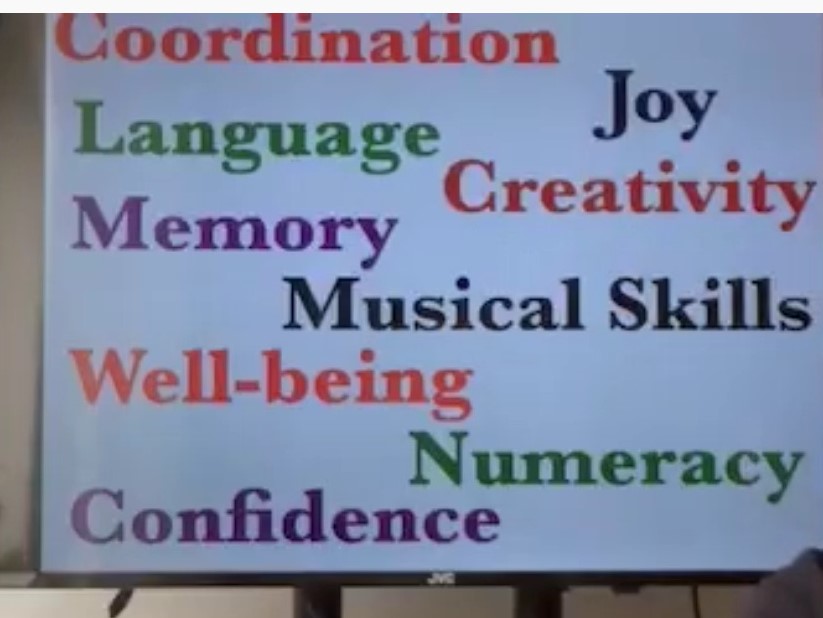
The featured image shows a screenshot (Figure 2) from the excellent Nicola Benedetti Virtual Sessions (May 2020) shows the numerous benefits which a music education (in this case Kodaly) can give young people. The Burnfoot project would aspire to impart these skills to the young musicians over the course of time.
Sheila Sapkota 14007570. Burnfoot Housing Estate. Community Music Project